|
Restoring a motorcycle basically starts with making the
decision what you want to represent.
Several options are available ranging from making it mecanically sound as it
is regardless whether it is in a civilian guise or not to rebuilding it to
the supposedly factory standard or rebuilding it to a "rebuild" or "in-service"
standard.
All options are historically correct and it is basically just what you want
to represent.
Civilian use;
Civilian guise is perfectly "original" as after the war many motorcycles
were sold off to the public and most people did not want to ride around on a
green motorcycle and large numbers were usually painted black overall with
silver grey petrol and oil tanks. (see also
post war
civlian use page). It is this post war civilian use that allows
us to purchase and restore ex-military motorcycles in the first place.
Factory standard;
Factory standard is the most difficult option to choose because of the fact
that although a lot of in formation has surfaced over the years and is
compiled in the "Military Norton 1936-1945 WD-16H & Big Four" book, there
will always be certain uncertainties for reasons described in the book. As
nobody really knows which these are, very few people/nobody will be able to
discredit your choices unless they have positive proof that can be
corroborated through different sources.
Rebuilt machines;
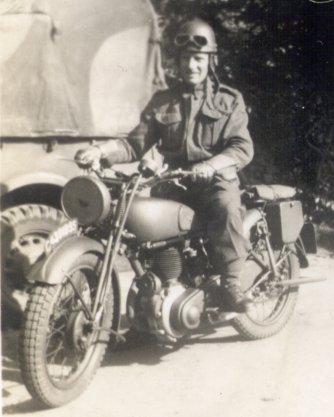
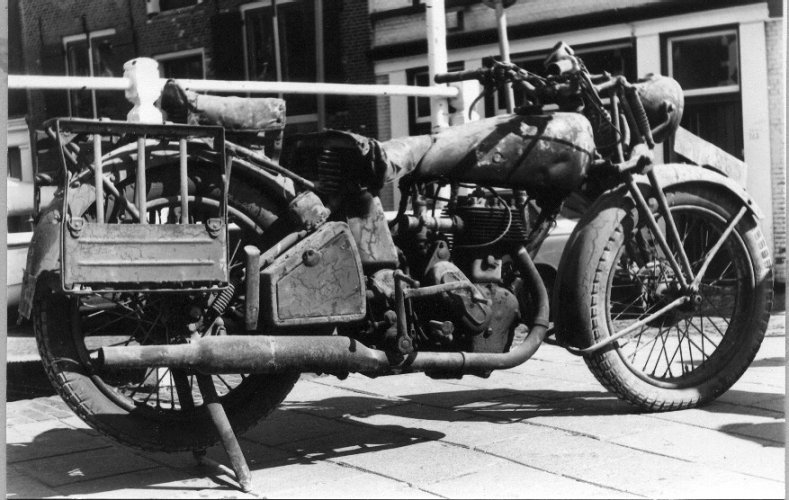
The motorcycle W31929 (engine nr 93803)
described below is one of the extremely rare examples where a
wartime picture exists of a present day motorcycle, although now with a
replacement engine.
|
|
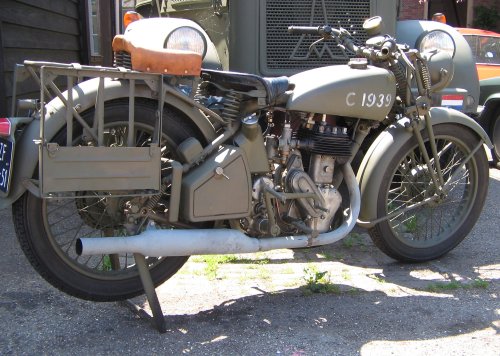
The above MC was actually made in 1941 under contract
C7353, and engine and frame number were originally identical/matching. The
engine presently in the bike number is however a 1939 number as the original
was too bad according to the owner., and not
originally fitted to this bike.
Based on the pre-restoration state with 6"headlamp, panniers and tubular
footrests it is most likely an official "rebuilt" machine delivered to the
Greek Army after the war.
The bike was obtained in the second half of the 70' ties by
the present owner, when a number of them were part of a greater batch of
ex-army Harley Davidson motorcycles purchased in Greece and brought
over to the Netherlands. Most bikes of that shipment were restored. Exact amount is
not known. This bike was my first encounter with a quite "original", unrestored bike. I used it as an example to find parts which I knew I was
missing, but had never seen in real life before.
In-service/field modifications;
From various wartime publications and
biographies which are still being published, it is evident that there was a
constant vigil to keep the motorcycles on the road. Cannibalizing was
officially forbidden by the
"Army Rules and Regulations", but was practiced in the field
by the responsible section fitters which tried to keep "their"
machines on the road.
In these cases even parts of other brands (BSA,
Triumph, Royal Enfield, Ariel, Matchless etc.) were used to obtain an
operational working motorcycle. One option seen was a Norton 16H with
Matchless "Teledraulics" instead of the girder front fork.
|
|
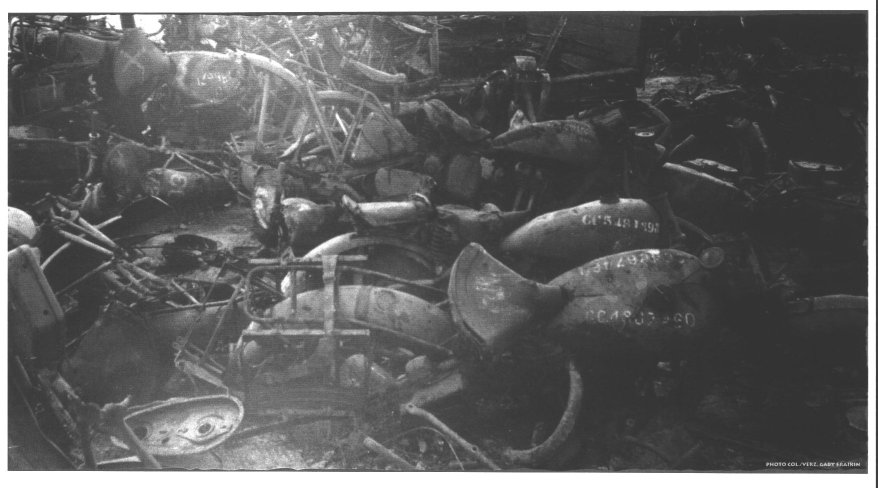
Discarded, abused and forgotten. Would be a restorers candy box now!
Part or all ex-Canadian machines based on the CC prefix on the census
number.
In
short, whatever you make of it there is not really any restoration that is
incorrect as long as it is stated as such and not portrayed as "it is all
original", which would be a lie.
|