|
Introduction
Markings on military vehicles are to be divided into those to
register an individual vehicle for administrative purposes and
additional unit and tactical markings showing the vehicle position in the actual army as a whole. Military unit/tactical markings
are a
whole field of investigations and is done much better in books like
British Military Markings 1939-1945 by Peter Hodges.
I therefore limit this page to the application of registration
numbers as applied to British military motorcycles and can be used
to finish an MC in military guise in a relative correct way.
Similar to the application of colours, there were rules and regulations, and
practical circumstances leading to a certain level of irregularities.
Next info is limited to the British military in the period
between 1936 and into the 50'ties when WD Nortons were built and
used, unless indicated otherwise.
Upto 1939 all British military vehicles were given both a civilian
registration plate (Middlesex series numbers for the Army) and a "painted on" military Census number (also
refered to as WD number).
Army, Navy and Airforce all had a seperate service related numbering
system.
The application of civilian registration was deleted in 1939 leaving
only the military census number for identification. Already released
civilian numbers remained on the MC's but were subsequently removed
as result of new regulations, during maintenance or write-offs.
For the British Army, census numbers were initially applied at the
(Royal Army Ordnance Corps) RAOC Central Ordnance Depot Chilwell, the primary receiving and distribution centre.
From 1940 onwards, the census numbers were applied by the individual motorcycle
manufacturers in blocks reserved by RAOC Chilwell as evidenced by
pictures inside the BSA factory, no such pictures are available of
the Norton production line but the 1940 contracts C5612 (16H) and
C5333 (Big4) show that extra money was paid for the application of
the numbers.
Comparison of several sources has proven that the census numbers
were applied in sequence with frame numbers from the second Norton contract
in 1936 onwards,
unfortunately it is not clear for part of the prewar contracts when
these were amended with additional machines (e.g. contract C9681) or
mixed with other production (in case of contract C3655 where 55
WD16H frames were used to mount Model 18 OHV engines. The first 1689
MC's of contract C9681 and the first 973 MC's of contract C3655 can
be calculated. Unknown which combination frame and census number were used for
both these additional/deviating MC's of C9681 and C3655. Census
numbers for contract C7371 can also not be properly traced.
RAF machines were mostly distributed from RAF Maintenance Command
Hartlebury, and it is assumed that the service specific numbers were
allocated there. Prior to the war the RAF only used civilian numbers
which appear to have been allocated in Middlesex as well.
Navy numbers were possibly allocated by Naval Ordnance Department in
Bath.
The Belgian Royal Enfield enthusiast Jan Vandervelde has done
pioneering work to recover as much as possible of the RAF and RN
registration numbers and the results can be found on this
HMVF forum thread.
For classification purposes, the Army used a letter prefix to the
census number, e.g. T for tanks, L for lories, A for ambulances, C
for motorcycles etc.
During a certain period the Canadians used an additional C in front
of the British Army classification letter, but retained the original
number.
Australian army MC's used in their home region were given their own
series of census numbers but they also changed census numbers for an
individual machine depending on the Service using them
(see AWM page).
Vehicles of Allied Free Forces from occupied countries (e.g.
Norwegian, Chech, Dutch etc.) were in a number of cases
re-registered with separate series of census numbers (for
example see Prinses Irene Brigade page). The originally applied
British numbers were most likely removed from the British
administration.
Different ranges of census numbers was reserved for impressed civilian machines.
All military motorcycles up to 1949 were registered with a C
followed by a 5 to 7 digit number. Unclear when this started but
definitly valid in the period the Nortons were built and used.
Initially, the first 2 numbers were an indication for the year of
application, 35xxxxxx to 39xxxxxx numbers can therefore be traced
back fairly easy to 1935 thru 1939.
The enormous increase in required vehicle numbers in 1939 made this
system untenable and the relation with year of introduction was lost
afterwards.
Additionally, during the war, dilapidated machines were completely
dismantled, and "rebuilt" with whatever parts available in special
workshops. These motorcycles were given a new identity (Census
numbers between C1400000 to C1499999, not related to specific makes
or sequence).
Around 1949 all motorcycles remaining on active Army duty were
re-registered with a civilian type number and the previous census/WD
numbers were removed and number plates re-introduced. This transfer
from one system to another is recorded in so called "Key Cards" (now
partly
kept at the
RLC museum in Deepcut, Surrey)
which show which MC/census number was linked to which post-war
number. (see also key cards page)
Application and positions of registration numbers:
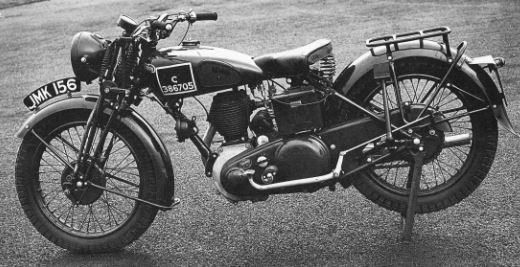
The civilian number plates used on military MC's were the usual for
the period, black background with white lettering, either hand
painted or by use of a template and fixed to both front and rear
mudguard (see below), three letters followed by three numbers, where
the letters indicate (in different blocks) the county where the
vehicle was registered, mostly Essex for the army.
 IWM
picture
IWM
picture
No guideline has been discovered for application of the census
number for the period of 1920ties to 1939. The
census number was only applied on the near side of the petrol tank
and usually
in a black rectangle with white lining (1938 example shown above). Box outer
dimensions on these machines approximately; height 4 5/8", width 5 5/8" and line width
1/4".
The letters/numbers on motorcycles were approximately half the size
of those applied to WD cars/lorries/trucks and approx half of the
civilian numbers.
Study of a number of pictures do however indicate to smaller letter
sizes approx. height 1 1/8" and width 3/4".
Original examples and contemporary pictures show that the rectangle and numbers were initially applied
by hand, where lateron census numberts appear to have been applied
with the aid of templates as well.
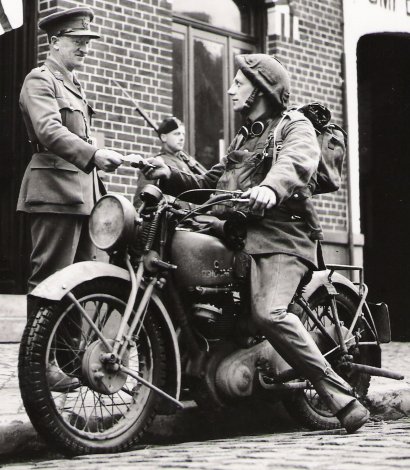
With the start of hostilities (1939 and BEF) it appears that many
black rectangles and civilian number plates were painted over in
green and that the census numbers were re-applied on either the
original numberplates or both sides of the petrol tank and rear
number plate, or as can be seen in picture, painted over just
around the number .
 IWM
picture
IWM
picture
Army Council Instructions A.C.I. 465 of may 1940 shows general
guidelines for the application of registration markings but
basically written with "B" vehicles in mind (describing bonnet and
rear of vehicle) but likely to be seen as general guideline for
motorcycles as well. It appears to specify the already used
practices retrospectively.
Marking on motorcycles to be 1 3/4 inch high and 1 1/4 inch (i.e.
half of the ones used on other vehicles). There was no set typeface
for these numbers and there are difference noticable between MC
brands.
A.C.I. 2261 Oct 1942 states to apply numbers on off-side and
rear-side only to preserve paint.
A.C.I. 1672 from November 1942 however specifies numbers to be
painted in white (or blue if Airborne) and on both sides of the
petrol tank only. Change from recent A.C.I. 2261 possibly because by
this time motorcycles did not usually have a rear number plate
anymore.
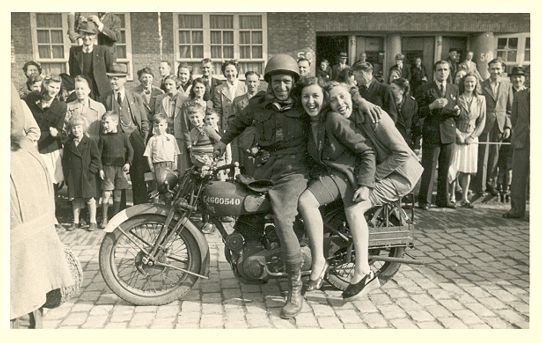
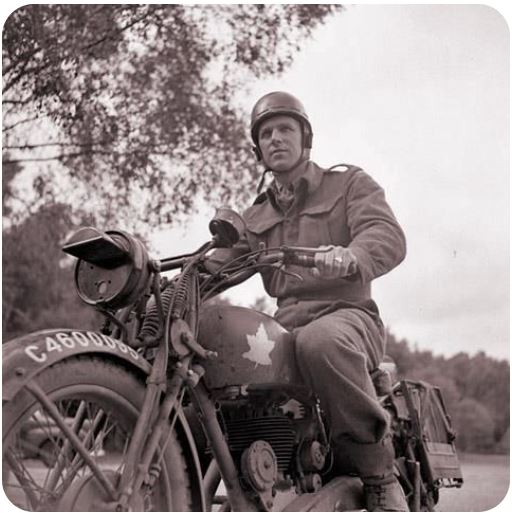
Pictorial evidence also show machines with the census number on both
sides of the front mudguard and not on the petrol tank mostly those
in use by the Canadians.
|
